Travel & Tour Management
April 7, 2026 2026-06-24 23:48Travel & Tour Management
Higher National Diploma in Travel & Tour Management
The University College of Ratmalana's Higher National Diploma (HND) in Travel & Tour Management is a nationally acclaimed curriculum created to provide qualified personnel for Sri Lanka's developing tourism sector. The curriculum ensures that graduates are well-prepared for tour operations, travel agency operations, tourism products development and other small and medium-sized business units relevant to the tourism industry by integrating solid theoretical foundations with extensive practical exposure and aligning with the national vocational framework.
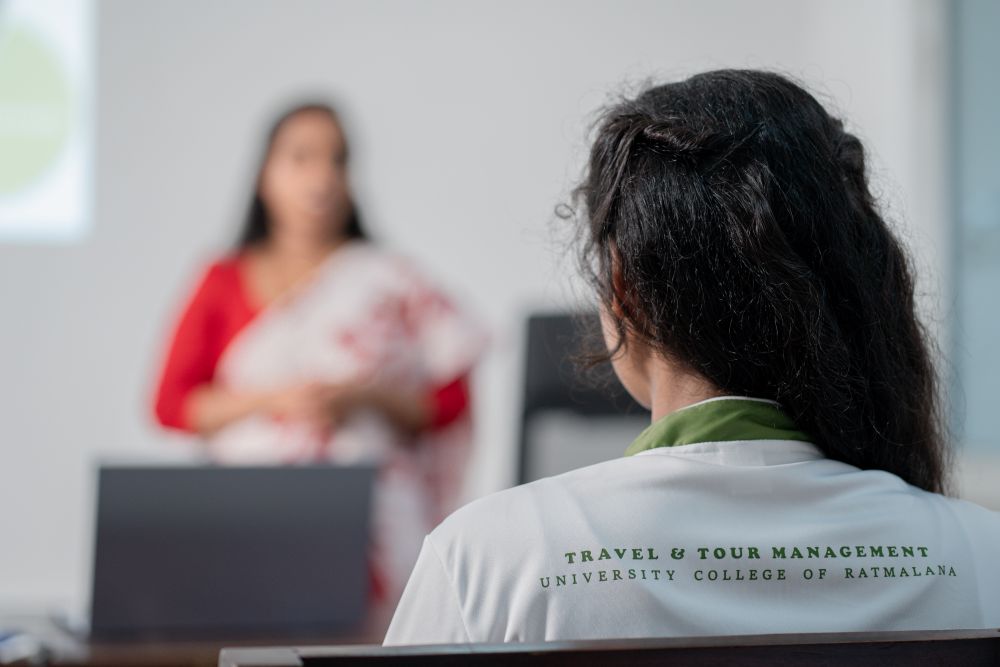
Program Structure and Theoretical Foundation
The HND in Travel & Tour Management is designed to gradually expand knowledge from the fundamentals of tour operations to the development of tourism products, infrastructure and resource management, and applied research techniques for the travel and tourism industry. Students are able to understand the development of tourist products and destination operations through the program's strong theoretical foundation.

Core theoretical subjects include:
- Community Based Tourism
- Introduction to Tourism
- Travel Management
- Travel Agency Operations
- Designing & Development of Tourism Products
- Human Resource Management for Travel and Tour operations
- Financial Management and Accounting
- Tourism Infrastructure Management
- Resource Management in Tourism
- Legal issues in tourism industry
- Tourism Economics
- Applied Research Methods
Through lectures, tutorials, structured assessments, and field visit-based observations, students learn how to comprehend the dynamic trends in the tourism and hospitality industry and how to enhance the current tourism products. They also learn how to design and develop new tourism products to meet the current and future demand for travel in both domestic and international contexts.
Practical Training and Industrial Exposure
One of the main tenets of a qualification is practical competency. In order to reinforce theoretical learning through practical experience, the curriculum incorporates field visit-based observations, survey sessions, and workshop practice. A key highlight of the program is the structured On-the-Job Training (OJT) period conducted in collaboration with industry partners. During this phase, students engage in industrial trainings related to:
- Travel Agency Operations
- Travel Management
- Supply Chain Management
- Human Resource Management for Travel and Tour operations
- Promoting Tourism Product
This exposure bridges the gap between academic study and professional practice.
Learning Resources and Facilities
The University College provides modern facilities to support academic and practical learning. These include:

- Computer Laboratories for Simulation and Design
- A Resourceful Library with Technical Textbooks and Journals
- Internet and E-learning Facilities
Students also benefit from industry-linked training opportunities and access to updated technical standards and reference materials. The learning environment is structured to promote discipline, technical accuracy, and innovation.
Academic Staff and Expertise
The curriculum is taught by skilled faculty members who have experience in both academia and tourism industry. Strong backgrounds travel & tourism operations are possessed by lecturers from the institution and from other industrial relevant organizations. Numerous employees increase the relevancy of lectures by bringing real-world industry experience into the classroom. Students receive individualized help throughout their studies thanks to ongoing academic advice, mentoring, and assessment feedback.
Module Code | Technical Module | Notional hours | Number of Credits |
NVQ Level 5 Qualification Semester 1 | |||
H55T001M01 | Introduction to Tourism | 175 | 7 |
H55T001M02 | Information services for Tourism | 150 | 6 |
H55T001M03 | Tourist services | 175 | 7 |
H55T001M04 | Travel Management | 250 | 10 |
EMTM01 | Workplace Information Management | 75 | 3 |
EMTM02 | Workplace Communication Management | 50 | 2 |
NVQ Level 5 Qualification Semester 2 | |||
H55T001M05 | Travel Agency Operations | 150 | 6 |
H55T001M06 | Designing and development of tourism product | 175 | 7 |
H55T001M07 | Selling Tourism Products | 150 | 6 |
H55T001M08 | Human Resource Management for Travel and Tour operations | 125 | 5 |
EMTM03 | Planning and Scheduling work at workplace | 75 | 3 |
On the Job Training (06 months) 6 Months on the Job Training under the supervision of NAITA. | |||
|
|
|
|
NVQ Level 6 Qualification Semester 1 | |||
H55T001M09 | Financial Management and Accounting | 150 | 6 |
H55T001M10 | Tourism Infrastructure Management | 150 | 6 |
H55T001M11 | Tourism Infrastructure Management | 75 | 3 |
H55T001M12 | Resource Management in Tourism | 150 | 6 |
H55T001M13 | Legal issues in tourism industry | 125 | 5 |
EMTM04 | Problem Solving and Decision Making | 50 | 2 |
EMTM05 | Teamwork and Leadership | 50 | 2 |
NVQ Level 6 Qualification Semester 2 | |||
H55T001M14 | Tourism Economics | 100 | 4 |
H55T001M15 | e-marketing and e-business in Tourism | 50 | 2 |
H55T001M16 | Promoting Tourism Products | 150 | 6 |
H55T001M17 | Risk Management in the Tourism & Hospitality industry | 50 | 2 |
H55T001M18 | Applied Research Methods | 150 | 6 |
H55T001M19 | Supply Chain Management | 200 | 8 |
EMTM06 | Creating and maintaining of learning culture | 50 | 2 |
On the Job Training (06 months) 6 Months on the Job Training under the supervision of NAITA. | |||